
What horse racing betting in New Zealand actually looks like this year
 Available in US
New Zealand runs a horse racing betting market that most other countries do not have: a single, lawful provider, no licence register to check, and a monopoly that started on 28 June 2025 under section 74AAA of the Racing Industry Act 2020. That single fact reshapes almost every other question a punter might ask, because the operator list shrinks from an open market to two branded apps, the complaints route collapses to one, and every “alternative” offshore brand appearing in search results is, by New Zealand’s own regulator, on the wrong side of the law.

Last updated 26 October 2026 · Verified against the Racing Industry Act 2020 (as amended), the Department of Internal Affairs’ public statements, and the New Zealand App Store listings for TAB and Betcha.
Table of Contents
- The shape of the market under section 74AAA
- What the law actually says about horse racing
- Responsible gambling in a single-operator market
- Bonuses, bonus bets, and what the marketing word actually buys
- The app and the handsets most punters bet on
- Live betting and cash out in a single-feed market
- Predictions, form, and the betting-system vocabulary
- How odds, stake, and return actually work
- The racing codes, the fixtures, and where they line up
- How betting actually happens on the day
- What the math on a single market actually shows
- The top 10 — what sets each one apart in the comparison
- How to read the comparison
- What changes over the next twelve months
- Frequently asked questions
The shape of the market under section 74AAA
The amendment to the Racing Industry Act 2020 — section 74AAA — says that no person other than TAB NZ may offer racing betting, sports betting, or other racing or sports betting to a person in New Zealand. The change took effect on 28 June 2025; the Department of Internal Affairs followed up by telling unlicensed providers serving New Zealand to withdraw with immediate effect. There is no licence register for bookmakers because there is only one lawful operator to put on one.

Two brands sit inside that operator: TAB itself and Betcha, the mobile-first brand of the same group run by Entain New Zealand Limited. They are not rivals — they share the same account wallet across TAB and Betcha, the same product feed, and the same Responsible Gambling tools, and a single exclusion on one applies to the other. TAB NZ’s 25-year operating partnership with Entain, signed in 2023, sends at least NZ$150 million a year to TAB NZ for the first five years on top of Entain’s one-off NZ$100 million payment to the racing sector. That structure is why Betcha can look and feel like a different bookmaker while being, regulatorily, the same counterparty as TAB.
The consequence for a person placing a bet in New Zealand is straightforward. The lawful channel is short, and the cost of stepping outside it falls on the operator under New Zealand law and on the player in a different way: no New Zealand complaints framework reaches them, winnings have no enforced payout, and DIA explicitly warns that unspent credits may not be returned. Either side of that boundary has a cost; picking a side means owning the one your side carries.
What the law actually says about horse racing
The relevant statute is the Racing Industry Act 2020, with section 74AAA inserted by the Racing Industry Amendment Act 2025 and in force from 28 June 2025. Pre-amendment, only TAB NZ was permitted to take bets in physical New Zealand outlets; the 2025 amendment extends that monopoly to online bets, which is the gap that international bookmakers had been filling. The penalty for breaching section 74AAA is not stated in the section, and no prosecution of an offshore bookmaker was found at the time of writing. For the player, section 19(4) of the Gambling Act 2003 (inserted in 2025) says an individual may not be convicted for placing a bet with an offshore operator in breach of section 74AAA; no published penalty for a player was found either.
The ban reaches events held inside and outside New Zealand. It does not matter whether the race is at Trentham, Ellerslie, Randwick or Royal Ascot — the monopoly covers the relationship between the bet and the punter in New Zealand, not the location of the race. That is why every offshore brand reviewed here is marked not licensed in New Zealand: they may, in their own terms, accept a New Zealand account, but New Zealand’s regulator advises them not to do so.
The Gambling Act 2003 remains the umbrella statute, and the Department of Internal Affairs is the regulator that enforces the prohibition on competing betting under section 92A of the Racing Industry Act. The Online Casino Gambling Act 2026 sits beside it and licenses online casino gambling only — winning the right to apply for a casino licence does not extend the betting monopoly. Greyhound racing is being wound down in stages from 1 August 2026; from that date offshore operators may not take bets on greyhound races either.
Responsible gambling in a single-operator market
A market with one provider means a player protection regime with one provider. TAB NZ lists deposit limits, time-outs and self-exclusion in its apps, and exclusions carry across both TAB and Betcha because they share a wallet. The app carries a 17+ App Store age rating while stating that customers must be 18 or over to bet, and the legal minimum for sports and racing betting is 18 — a separate threshold from the 20+ age for land-based casinos, which is a different gambling permit with different rules.
The free Gambling Helpline (0800 654 655, text 8006) and Safer Gambling Aotearoa are the published referral routes. TAB NZ pays a Problem Gambling Levy of 0.74% in the current three-year cycle (1 July 2025 to 30 June 2028). No single national online-betting exclusion register covers sports and racing; the register the 2026 casino law will introduce is for online casinos only, and any overlap with sports betting is not established. Punters who want a hard “no-platform” stop can put a bank block on gambling merchants at the card level, but that sits outside the betting regulation itself.
The offshore case carries none of this. No New Zealand complaints route reaches it. No harm-minimisation framework reaches it. No regulator oversees its payout timelines, fixed-odds suspension rules, or the security of stored funds. That is what DIA means when it warns that overseas operators “may be in jurisdictions with minimal consumer safeguards, may not return unspent credits and may not pay out large wins”. The first operator row in the comparison table below makes that explicit; the rest of the row carries the data it does carry.
Bonuses, bonus bets, and what the marketing word actually buys
The honest reading of a “bonus bet” at TAB NZ is the same as the honest reading at any bookmaker: the bet is paid out at the winning price, but the stake is usually not returned with the win. The bet is, mechanically, a free stake priced against a chosen outcome. A punter’s edge on a bonus bet is the value of the price they have chosen once the stake is removed from the equation — price, not generosity, is the engine.
Neither TAB NZ nor Betcha carry wagering requirements on the welcome bonus of the kind the offshore brands studied here advertise (multipliers of 35x and 40x for casino deposits). The way the New Zealand operator frames a bonus bet is closer to a single-use credit than a deposit match with a playthrough, which is the practical reason the offshore market’s headline numbers look so much larger. A 100% match up to EUR 100 that requires 35x turnover on the bonus plus deposit is not worth EUR 100 in real terms; a TAB bonus bet at face value is worth whatever the chosen runner’s price implies, less the vig the tote/fixed-odds price has already built in.
What to check on any bonus bet, anywhere: the minimum odds, the eligible markets, the deadline, whether winnings from the bonus bet are capped, and whether the bonus bet is paid back as cash or as further bonus bets on a win. TAB NZ’s terms publish these; offshore brands’ terms publish these; readers are advised to read them before claiming. The “incentive” cluster in the wider New Zealand horse racing betting vocabulary covers matched-betting arbitrage, abuse of bonus eligibility, and the slow bleed through minimum-odds restrictions — each of which is a different problem with a different answer, and none of which is solved by taking a bigger headline.
The app and the handsets most punters bet on
TAB NZ publishes its betting app, TAB — Racing & Sports Betting, on the New Zealand App Store under the seller name New Zealand Racing Board; the app was first released on 8 September 2014 and predates the modern multi-brand betting app era by a wide margin. It carries horse and harness racing, rugby union, rugby league and other sports, with pre-match and live markets, and bundles in Trackside live race streaming with in-app betting. Racing form, Blackbook and Jockey Challenge sit inside the app alongside a wallet that handles deposits and withdrawals under one surface.
Betcha, the mobile-first brand of TAB NZ, was first released on 6 August 2024 and is published by Entain New Zealand Limited. It carries the same product feed, the same racing markets, and shares the same wallet as TAB. For a punter choosing between the two, the practical difference is which interface they prefer for placing a multi or a same-game multi, and which push notification set they prefer to tolerate — not which operator is taking the bet.
The mobile question, on this market, is downstream of the legal question. An offshore sportsbook app installed on a New Zealand phone does not change who TAB NZ is. A punter preferring browser-based betting is unlikely to find TAB NZ’s products more limited than the offshore bookmakers’, because the catalogue depth is set by TAB NZ’s terms rather than by the device.
Live betting and cash out in a single-feed market
Live betting odds on horse racing exist on TAB and Betcha the way they do at any major bookmaker: the price moves as the race unfolds, and the bet must be accepted before the relevant leg closes. The price ladder reflects what the market has already judged about each runner’s chance at each moment, and the bookmaker’s margin is the share of one unit the platform keeps across all runners, which is why two runners can show up at 1.85 and still be a worse market than 1.90 and 1.90.
Cash out — locking in a smaller win or a smaller loss while the bet is still live — sits inside TAB NZ’s offering the way Trackside streaming does, as part of the in-app product. Its economics depend on the live price at the moment of the cash-out request, not the starting price, and the wider the margin, the wider the haircut on cash out. A punter expecting cash out to be a coin flip with the bookmaker is wrong: the bookmaker wins on average over every cash out, because the margin is still inside the live price.
Horse racing’s live betting surface is different from football or tennis. There is no extended in-play phase; the live window is the race itself, plus a few minutes before the start. That short window makes impulse betting easier and disciplined betting harder, which is why a punter setting a time-out or a deposit limit before sitting down to a meeting is doing more than the bonus word “responsible” suggests.
Predictions, form, and the betting-system vocabulary
The prediction cluster is dense in horse racing and thin in evidence. There are stable-money services, tipsters, ratings models, sectional-time readers, jockey-and-trainer combination tools, and a long history of systems that promised an edge and did not deliver one. None of them overturns the structural fact that the bookmaker’s margin sits inside every price — that is the bookmaker’s edge, and no tipster returns it. A punter’s edge, where one exists, is in finding a price that is mispriced relative to the true chance of the runner winning; that requires form, but it requires the bookmaker to have under- or over-valued the runner, which is a price-relative question, not a form-knowledge question.
Matched betting — laying a runner at a betting exchange to lock in a profit from a bookmaker’s free bet — depends on having a betting exchange, which New Zealand does not lawfully provide. New Zealand-licensed betting exchanges are outside TAB NZ’s sport-and-racing definition; the matched-betting search terms in the cluster around “best time matched betting strategy horse racing” hit affiliate pages written for markets where exchanges exist, and they are read as offshore how-tos rather than New Zealand-licensed systems. The cacheable answer for a New Zealand punter is that a structured matched-betting framework is not available inside the TAB NZ monopoly.
Bankroll management is the part of strategy that travels across markets: a flat stake as a share of the bank; no chasing losses; a stop-loss for the day; and a record that punter can read back. These are not betting systems; they are the discipline that lets a punter tell, over time, whether the prices they picked really were better than the market’s.
How odds, stake, and return actually work
Decimal odds are the standard across TAB NZ. A bet of NZ$10 on a runner priced at 2.10 returns NZ$21 if the runner wins, of which NZ$11 is profit. A combination bet multiplies the odds of each leg into one price — three legs at 2.00, 3.00 and 4.00 read as 24.00 on the bet slip, and a NZ$5 stake returns NZ$120 if all three legs win. This is the underlying mechanic behind every “multi” or “Same Game Multi” punters see in the app.
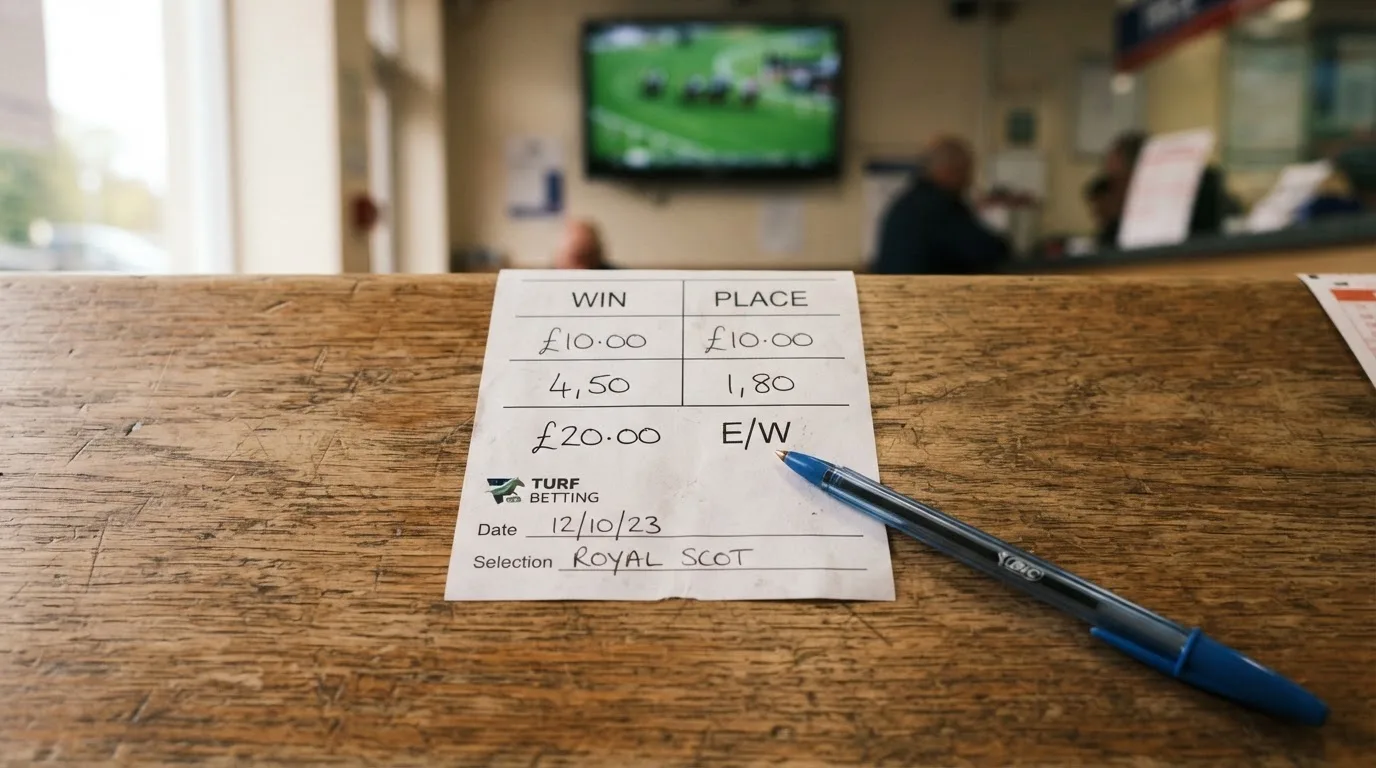
Each-way betting is two bets, not one: a win bet and a place bet, and the stake is doubled. A NZ$10 each-way bet costs NZ$20, with NZ$10 on the win side and NZ$10 on the place side. Under UK-style each-way place terms — handicaps with more than 15 runners pay 1/4 odds for 4 places, 12 to 15 runners 1/4 odds for 3 places, other races with more than 7 runners 1/5 odds for 3 places, 5 to 7 runners 1/4 odds for 2 places, and fewer than 5 runners win only — the worked example is instructive. A NZ$10 each-way bet on a 10.00 horse at 1/4 place terms (3 places) costs NZ$20, returns NZ$110 for the win part and NZ$35 for the place part, so NZ$145 in total if the horse wins, and NZ$35 if it only places. The dual nature of each-way is exactly why a punter picking a long-shot top-three chance has a different bet to make than a punter picking a strong favourite.
The handicaps cluster is about weight, not margin. In a handicap, each horse carries a different weight set by the handicapper based on past ability, with the goal of making the field competitive; in a conditions race, horses carry the same weight with allowances for younger horses and fillies or mares. The punter’s price reflects the handicapper’s view, and the punter’s job is to take a position on whether the handicapper has the right one.
The racing codes, the fixtures, and where they line up
New Zealand racing splits into thoroughbred, harness (“trots”), and greyhound — the three codes a New Zealand punter meets in a TAB NZ betting program. Greyhound racing is closing in stages from 1 August 2026, and after that date no betting on greyhound races can be taken through TAB NZ or by an offshore operator serving New Zealand. Thoroughbred meetings run year-round at Trentham, Ellerslie, Riccarton, Te Rapa, Wingatui, Tauranga, Matamata and others, with the spring and autumn carnivals drawing the deepest fields and the biggest tote pools. Harness racing runs alongside, with the New Zealand Trotting Cup meeting and the Inter Dominion as headline events.
The international fixtures a New Zealand punter bets on through TAB NZ include the Melbourne Cup at Flemington on the first Tuesday of November, the British Triple Crown (the 2000 Guineas, the Derby and the St Leger), Royal Ascot, and a long tail of European, American and Asian Group events. Distance ranges in flat racing go from around 400 metres to more than six kilometres, with five to twelve furlongs (one to 2.4 kilometres) the most common band. Jump racing — steeplechasing and hurdling, called National Hunt racing in Britain and Ireland — sits inside TAB NZ’s coverage in a smaller window.
A New Zealand punter evaluating any racing product — whether it is TAB NZ, Betcha, or a bookmaker serving them from offshore — is advised to check that the product publishes a full form guide, a live dividend table for the tote, and an in-play price ladder for the day’s meeting. Where any of those is missing, a punter bets on the published offering less than its full information.
How betting actually happens on the day
A horse race bet at TAB NZ starts the same way as anywhere: open the app or visit the website, sign in, and open the next meeting. Choose a race, look at the runners, compare the fixed-odds price against the tote pool (TAB NZ runs both fixed-odds and tote/pool bets), pick a stake, and place the bet.
The stake comes out of the punter’s wallet. The wallet is funded by a deposit method TAB NZ accepts — the methods live in the operator’s own terms and may change, so the operator’s deposit page is the only honest source. The bet settles when the race result is official, with TAB NZ’s betting rules defining everything the punter needs to know about dead heats, protests, voids and walkovers. A punter who has not read those rules once is punting on a product they do not yet understand.
Withdrawal of winnings — the punter’s primary concern on the way out — runs through the same wallet, back through the same method if possible, and subject to TAB NZ’s processing windows. Where a punter expects the offshore “same-day payout” benchmark seen across the international market, TAB NZ’s terms set the actual pace. Any bank-level delay (clearing, fraud checks) sits on top of TAB NZ’s window and is not TAB NZ’s to compress.
What the math on a single market actually shows
To see how the operator’s margin works, take an illustrative two-way market — a coin-flip outcome priced by the bookmaker at decimal odds 1.90 and 1.90, before looking at a real TAB NZ race and seeing the same shape with one shorter runner and one longer. The fair payout share at exactly 2.00 and 2.00 is 100% — for every NZ$1 staked, the punter is returned NZ$1 across both outcomes. The bookmaker builds the margin in by shortening both sides below 2.00.
The arithmetic goes like this. Payout share = 1 ÷ (1/odds₁ + 1/odds₂) = 1 ÷ (1/1.90 + 1/1.90) = 1 ÷ (0.5263 + 0.5263) = 1 ÷ 1.0526 ≈ 0.95. Margin = 1 − payout share = 1 − 0.95 = 0.05, or about 5%. That is the share of every NZ$1 bet on this market that the operator keeps, on average, before any other vig — bonus offers, payment costs, customer service — is layered on.
The condition, not just the number, is what the punter needs. The 5% figure describes a perfectly balanced two-way market at 1.90/1.90. Tote pools with unbalanced payouts return a different share because the dividend is recalculated from the pool once betting closes. A 10-runner field with a 25% favourite and 8% rags is wider than 5%. A narrow race with a 1.30 favourite and a 4.00 second-favourite is closer to 5% on the favourite side and much wider on the second-favourite side. The band matters; the single number does not.
The sharp reading is that the operator’s edge is the price, not the punter’s luck. Across many bets, even an accurate form reader who beats their own prediction 60% of the time loses money at a 5% margin if their price is the market price, because the market price already paid the operator for the operator’s view of that 60%. The edge has to come from beating the price, which is why a Same Game Multi on a favourite is rarely a long-term winner and why the strategy cluster exists at all.
The top 10 — what sets each one apart in the comparison
There are ten operators in this comparison, divided by law into a lawful monopoly (two brands of one operator) and the offshore rest (eight bookmakers that are not licensed in New Zealand). The table presents the lawful status first, then what the operator’s own terms publish about its racing and betting product. Where a column shows no data, the wording is the article-language no-data marker; an em dash is reserved for a single rare gap, not a pattern.
| Brand | New Zealand status | What the operator’s own terms state |
|---|---|---|
| TAB | TAB NZ brand (lawful) | Retail, app, and online; full racing and sports product; Trackside streaming; deposit limits, time-outs, self-exclusion across TAB and Betcha; 18+ to bet |
| Betcha | TAB NZ brand (lawful) | App-first; same product feed and wallet as TAB; racing pre-match and live; 18+ to bet |
| Rooster.bet | Not licensed in New Zealand | Live, Sports Promotions, Results, Schedule, E-sports, Predictions sections; odds in six formats; Tobique licence (no NZ validity) |
| Golden Panda | Not licensed in New Zealand | Casino, live casino, sportsbook, esports, virtual sports, crash games, cashback, VIP Club |
| BetNinja | Not licensed in New Zealand | Casino welcome up to EUR 1,000 + 100 free spins; sports 100% match up to EUR 100 on first deposit |
| BetAlright | Not licensed in New Zealand | Football, tennis, table tennis, basketball, ice hockey, American football, baseball; Live Betting and Virtual Sports sections |
| FunBet | Not licensed in New Zealand | Football, ice hockey, American football, basketball, volleyball, tennis, rugby, baseball; live betting; 24/7 framed bookmaker |
| Spinbara | Not licensed in New Zealand | First deposit 100% up to EUR 100; crypto sport welcome 100% up to 200 USDT; casino welcome 100% up to EUR 500 + 200 free spins |
| 22Bet | Not licensed in New Zealand | Over 30 market types per event including 1X2, Double Chance, totals, BTTS, correct score, HT-FT; tennis game, set and handicap markets; Curaçao licence |
| Telbet | Not licensed in New Zealand | Crypto casino and sportsbook; Russian-language site shows 200% up to 1 BTC + 50 free spins + 5 USDT free bet |
TAB — the only lawful bookmaker
TAB sits at the top of the table because New Zealand law puts it there. The platform is the only lawful bookmaker for racing and sports for a person in New Zealand, its product is built around thoroughbred, harness and (until 1 August 2026) greyhound racing alongside rugby, cricket and a wide tail of other sports, and it is the only bookmaker from whom a New Zealand punter’s complaint reaches a New Zealand regulator. The app carries Trackside streaming, racing form, Blackbook and Jockey Challenge, and a wallet that handles deposits and withdrawals under one surface.
For a New Zealand punter, TAB is the default choice — not because the brand has earned a “best” rating in some abstract sense, but because every other row carries the legal and consumer overhead that offshore betting does. A punter who picks TAB is paying the widest catalogue of NZ-themed markets and the deepest regulator protection; a punter who picks any of the others is doing so on other terms, with other risks, and (since 28 June 2025) on the wrong side of section 74AAA.
Betcha — the mobile-first version of the same operator
Betcha is the second TAB NZ brand, the app-first sister of TAB published by Entain New Zealand Limited on the New Zealand App Store since 6 August 2024. The catalogue is identical; the wallet is shared; an exclusion on one applies to the other. The difference is ergonomic: the home screen, the navigation, the in-app notification set. A punter who finds TAB cluttered and wants a thinner surface for placing the same bet can use Betcha without changing who they are betting with.
For a punter who places most of their racing bets by phone and wants racing markets without a sportsbook in the way, Betcha is the better of the two experiences inside the same legal envelope.
Rooster.bet — sportsbook breadth with no NZ protection
Rooster.bet markets itself around six sections (Live, Sports Promotions, Results, Schedule, E-sports, Predictions) and supports six odds formats, which makes it technically convenient for a punter who reads prices in any market’s native convention. The brand’s licence is a Tobique Gaming Commission number under Novatrix SRL, which gives it no right to take bets from people in New Zealand. No New Zealand complaints route reaches it, no New Zealand harm-minimisation framework applies, and the operator’s own terms are the only terms that bind it.
For a New Zealand punter, the relevant comparison against TAB is not “better product” but “no New Zealand protection and against the law on the operator side”. A punter whose decisions are driven entirely by price and who accepts the DIA’s stated risks of unspent credits and unpaid winnings can find a wider market catalogue here than at TAB; the bargain is the absence of law, not a coupon.
Golden Panda — casino plus sportsbook under one roof
Golden Panda’s surface is casino-heavy, with a Sports section fronting a sportsbook, esports and virtual sports, plus a VIP Club, cashback, and Golden Goals and Prediction Markets features. The sportsbook depth is published lightly; the brand names no licence that applies in New Zealand, so every sports bet it accepts from a New Zealand resident sits on the wrong side of section 74AAA.
For a punter evaluating Golden Panda against TAB, the trade is product breadth in casino and a soft liability profile in sports — both of which the New Zealand law is specifically targeting. The appropriate position is to consider what data they can verify before betting, and what they cannot.
BetNinja — heaviest headline, palest paperwork
BetNinja leads with a casino welcome up to EUR 1,000 plus 100 free spins, and a sports 100% match up to EUR 100 on the first deposit. The headers are loud, the bonus terms are normally tighter than the headers suggest, and the licence is from the Union of the Comoros, which is not a New Zealand licence and never will be. The relevant caveats are the standard DIA risks: no New Zealand complaints route, no harm-minimisation framework, no enforced payout for New Zealand residents.
For a punter evaluating BetNinja on the sports side, the welcome bonus is the headline they need to read twice. The wagering requirement — typically applied to bonus plus deposit — is where the headline number resolves to a real cost, and the cost is rarely smaller than the cost of placing the same bet at TAB’s fixed-odds price.
BetAlright — North American and Asian sport lineup
BetAlright’s sportsbook lists football, tennis, table tennis, basketball, ice hockey, American football and baseball, with Live Betting and Virtual Sports sections backing them. The mix is heavy on North American leagues, light on New Zealand and Australian racing, and the brand lacks any New Zealand-valid licence.
For a New Zealand punter, the comparison against TAB is not the depth of tennis or American football — TAB carries those too — it is the depth of thoroughbred and harness racing that the punter cannot get here. The verdict on this column is short.
FunBet — 24/7 framed bookmaker with a rugby line
FunBet carries football, ice hockey, American football, basketball, volleyball, tennis, rugby and baseball, with live betting and a “24/7” frame. Rugby is the in-house differentiator for an Australian and New Zealand audience, and the rest of the catalogue is a standard offshore sportsbook menu. The brand carries no licence valid here.
For a New Zealand punter, rugby is one of the markets TAB NZ carries at greater depth and at the same speed, with the same live betting product on rugby union and rugby league. FunBet’s draw for a punter choosing against TAB is not what it carries, but what it does not.
Spinbara — three welcome offers on the same landing page
Spinbara publishes a first-deposit bonus of 100% up to EUR 100, a sport crypto welcome of 100% up to 200 USDT, and a casino welcome of 100% up to EUR 500 plus 200 free spins. Three offers, three currencies, three sets of terms — the practical reading is that the punters reading the smallest fine print of all three will be the ones whose bonus actually pays out.
For a New Zealand punter comparing against TAB, the draw is the headline number, not the comparison itself. The wagering, the eligible markets, the minimum odds, the time to clear, the cap on winnings — each of those terms is where the headline number ends up.
22Bet — market depth per event, deeper than the catalogue
22Bet advertises more than 30 market types per event, including 1X2, Double Chance, totals, both teams to score, correct score and HT-FT, plus tennis game, set and handicap markets. The depth-per-event is real and useful in football and tennis. The Curaçao licence (8048/JAZ, holder TechSolutions Group N.V.) is a recognised offshore licence, but it gives no right to take bets from people in New Zealand. Same DIA risks; same offshore fine print.
For a New Zealand punter, the draw is the number of ways to bet on a single football match — a place where 22Bet genuinely beats TAB’s depth per event. The cost is that the bets a New Zealand punter places here are illegal on the operator side, and the win a punter takes back to New Zealand may not be reachable if the operator’s home jurisdiction declines to pay.
Telbet — crypto-first, Russian-language availability
Telbet describes itself as a crypto casino and sportsbook, with a Russian-language welcome of 200% up to 1 BTC plus 50 free spins and a 5 USDT free bet. The English-language surface publishes less; the brand is unlicensed in New Zealand. Crypto funding has no New Zealand-specific rule in the betting statute, and account opening at TAB NZ requires a verified New Zealand address, but the law does not bar an individual punter from holding crypto elsewhere — it bars the operator from taking the bet.
For a New Zealand punter evaluating Telbet, the page’s standing position is unchanged: no New Zealand licence, no New Zealand protection, no place on the comparison’s “lawful option” row. The crypto funding does not change that and is not a recommendation one way or the other; it is a description.
How to read the comparison
The comparison above is read top to bottom by lawful status, not by “best to worst”. The first two rows are the same lawful operator expressed in two different shapes; the remaining eight are a representative sample of offshore bookmakers a New Zealand punter meets in search results and through affiliate marketing, each marked not licensed in New Zealand and each carrying the standard set of DIA risks. The verdict on each offshore row is not “avoid” — the page does not pass judgement on the operator’s existence — but the verdict is “no New Zealand protection”, which is the only verdict the comparison’s structure permits.
The table’s third column shows what each operator’s own terms publish. It is not a review; it is what the operator wants a New Zealand customer to know. Where the third column is empty, the publisher has nothing verifiable to publish; that absence is the cell’s content.
What changes over the next twelve months
Two near-term shifts are worth tracking. Greyhound racing is being closed in stages from 1 August 2026, and from that date no TAB NZ bet on a greyhound race and no offshore bet on a greyhound race from a person in New Zealand is lawful. The Online Casino Gambling Act 2026 sits beside the betting law and will introduce an online casino licensing regime; it does not, on its own terms, extend TAB NZ’s monopoly, but it is the closest thing New Zealand has to a secondary gambling statute on the horizon. The point-of-consumption charge on offshore racing and sports bets ceased on 30 June 2026; the implications for offshore operator behaviour and for DIA’s enforcement posture are not yet stated.
A punter following this market over the next twelve months is advised to watch three signals. First, the official racing calendar from the Racing Industry Board, which lists the meetings and codes that remain available. Second, TAB NZ’s published product news, which lists the app and bet-type additions the operator is making. Third, DIA’s published statements on section 74AAA enforcement, which describe the offshore end of the market in the regulator’s own words.
Frequently asked questions
How do I bet on horse races in New Zealand?
Open the TAB or Betcha app on your phone, sign in with your verified New Zealand account, choose the meeting and the race, and pick a runner. Place a fixed-odds bet on the win market, the place market, or as an each-way combination (a win bet and a place bet on the same runner). The stake comes out of your wallet and the bet settles when the race result is official under TAB NZ’s betting rules.
How does horse betting actually work?
A bet pairs a stake (the amount you risk) with a price (the decimal odds the bookmaker publishes for the runner winning). If the runner wins, the bookmaker returns stake times price to you and keeps the stake as profit. A combination bet multiplies the prices of each leg into one larger price; an each-way bet is two bets, a win bet and a place bet, and costs twice the stake.
How do odds work in horse racing?
Decimal odds show what a winning NZ$1 stake returns, stake included. A runner at 2.10 returns NZ$2.10 for every NZ$1 staked if it wins, of which NZ$1.10 is profit. The bookmaker’s margin is the share of every NZ$1 bet on a market that the bookmaker keeps — for example, a perfectly balanced two-way market at 1.90 and 1.90 has a payout share of about 95% and a margin of about 5%.
Which bookmaker may lawfully take sports and racing bets in New Zealand?
TAB NZ is the only provider lawfully offering racing and sports betting to people in New Zealand under section 74AAA of the Racing Industry Act 2020, in force since 28 June 2025. TAB and Betcha are the two online brands of TAB NZ; they are the same operator group, not rivals. No other bookmaker is licensed to take racing or sports bets from a person in New Zealand.
How is the return on a bet worked out from the stake and the odds?
The return is stake multiplied by the decimal odds. A NZ$10 stake at 2.10 returns NZ$21 if the runner wins — NZ$10 of stake returned plus NZ$11 of net profit. On a combination bet, the odds of each leg multiply into one price; a three-leg multi at 2.00, 3.00 and 4.00 reads as 24.00 on the bet slip, so a NZ$5 stake returns NZ$120 if all three legs win.
Published by the Nzinstantbanking team.