
Arbitrage Betting in New Zealand in 2026: The Arithmetic, the Law and the Price of Being Found Out
 Available in US
Current as of 26 October 2026 · verified against the Department of Internal Affairs and TAB NZ’s published terms.
The “mathematical edge” pitch for arbitrage betting has a quiet second clause, and that clause is what this article is about. Yes, the arithmetic is real. Two bookmakers who disagree on a football match leave a numerical gap, a bettor splits a stake across both outcomes and walks away slightly ahead no matter the final score. Nothing on the page needs the team to win. That part is true, and it is also the smallest part of the story. The bigger part is what the technique costs a person actually trying to run it from New Zealand in 2026: who is allowed to take your bets, what the only lawful bookmaker thinks of accounts that look like yours, what the math looks like at the size you can actually stake, and what happens when the model breaks down.
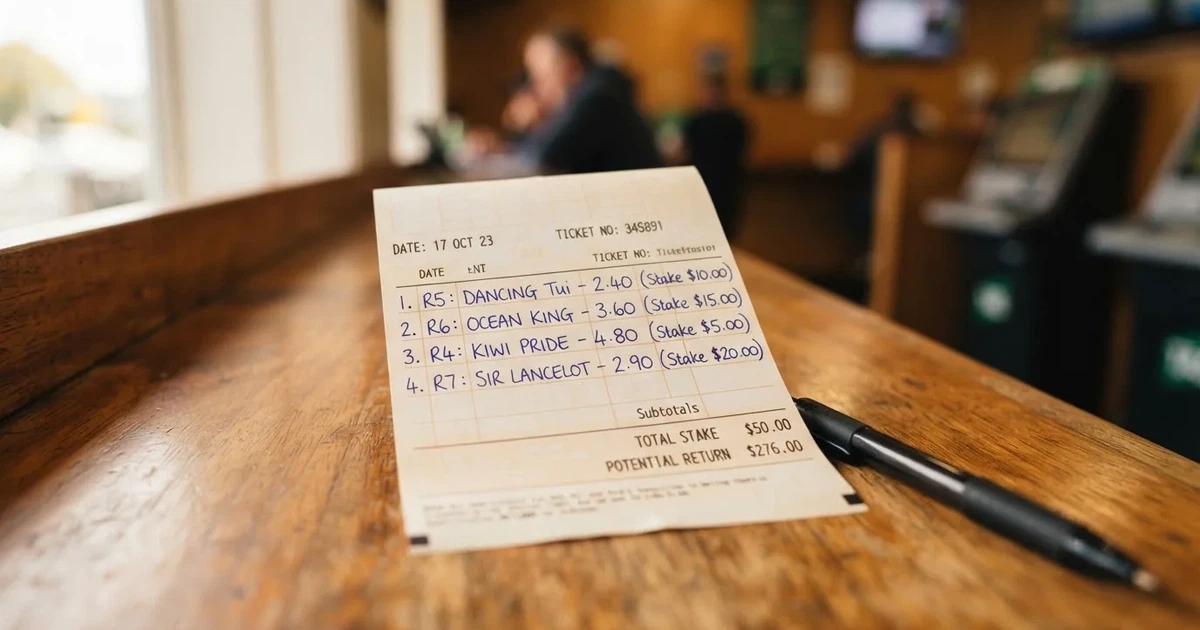
A few things up front, because they govern every paragraph below. Since 28 June 2025 the Racing Industry Act 2020, as amended by section 74AAA, makes TAB NZ the only operator that may lawfully offer racing and sports betting to people in New Zealand. TAB NZ runs two online brands — TAB and Betcha — and they are the same operator for legal and practical purposes. Every other bookmaker profiled below is not licensed in New Zealand. A technique that needs several bookmakers cannot be run inside the lawful system alone, and that is the starting condition this page works from, not a complaint about the reader.
Table of Contents
- The Statute Book First: Who Can Take Your Bet in New Zealand
- What an Arbitrage Bet Actually Is, in Numbers
- The Cost Side: What Running Arbitrage Actually Does to an Account
- The Offshore Question: What the Eight Brands Below Actually Are
- Why “Guaranteed” Doesn’t Mean “Risk-Free”
- Where This Leaves a New Zealand Punter in 2026
- Frequently Asked Questions
The Statute Book First: Who Can Take Your Bet in New Zealand
Section 74AAA of the Racing Industry Act 2020, inserted by the Racing Industry Amendment Act 2025 and in force from 28 June 2025, is the rule the rest of this page runs into. It says that no person other than TAB NZ may offer racing betting, sports betting, or other racing or sports betting to a person in New Zealand, regardless of where that person is resident or where the offer is incorporated. The Department of Internal Affairs, which monitors compliance with the betting prohibition under section 92A of the same Act, told providers serving New Zealand customers to withdraw with immediate effect on the same day the change took effect.

A couple of consequences follow from the rule, and they are not always the ones a searcher came in looking for. There is no licence to apply for, because there is only one lawful provider and no route for another. There is no register of bookmakers, because there is nothing to register. The law does not geo-block offshore websites — New Zealand ISPs do not filter bookmaker addresses — but the law puts liability on the offshore operator offering the bet, not on the player clicking the link. Section 19(4) of the Gambling Act 2003, inserted in 2025, says an individual cannot be convicted for placing a bet with an offshore operator that is in breach of section 74AAA; no source published a penalty for the player. The honest framing, and the one a New Zealand punter actually needs, is that the law targets the operator and the Department of Internal Affairs warns the player of the risks without naming a published punishment for placing the bet.
TAB NZ is a single business with two online brands. TAB (trading as tab.co.nz) and Betcha (trading as betcha.co.nz) are both operated under the long-term agreement signed with Entain in 2023, a 25-year deal that gives Entain a 50/50 share of gross profits and at least $150m a year going back to TAB NZ for the first five years, alongside a one-off $100m commitment from Entain to the racing sector. Treating Betcha as a rival to TAB is treating two shopfronts of the same counter as two different bookmakers. They share harm-minimisation tools, the same self-exclusion register and the same problem-gambling oversight. Players switching from one to the other to chase price differentials is not arbitrage. It is a transfer between sister brands of the same bookmaker.
The legislative landscape also reshaped itself around the casino side. The Online Casino Gambling Act 2026 licenses online casino gambling only; it does not license sports betting, and TAB New Zealand’s right to apply for a casino licence does not extend the betting monopoly. Greyhound racing in New Zealand is being wound down in stages from 1 August 2026, and from that date offshore operators may not take bets on greyhound races either. A punter looking at arbitrage mechanics who still wants to bet on greyhound races from offshore after 1 August 2026 is reading a closed door.
What an Arbitrage Bet Actually Is, in Numbers
Stripped to its bones, an arbitrage in betting is a mathematical condition, not a strategy. It exists when, on a market with a fixed set of mutually exclusive outcomes, the prices on offer from one or more bookmakers imply probabilities that sum to less than one. The simplest version is a two-way market, the home win and the away win: bookmaker A has the home win at 2.10 and the away win at 2.10; the implied probabilities are 1 ÷ 2.10 plus 1 ÷ 2.10, which equals about 0.952. The combined probability is below 1, the gap is the arbitrage, and a stake split between the two outcomes returns more than was put in whichever way the result goes.

That is the textbook example and it is misleadingly clean. Real markets are three-way — home win, draw, away win — and the second fact about arbitrage is that the prices almost never line up this neatly. A 2012 study by Franck, Verbeek and Nuesch, which became the standard reference, found that 98% of arbitrage opportunities on offer from mainstream bookmakers returned less than 1.2% on the stake. The remaining 2% are where the headline numbers come from, and they are also where the mistakes, the voids and the stake restrictions live. To capture a 1% return on a 1.20/1.20 line, a punter needs roughly equal stakes on each outcome; to capture the same 1% on a 1.50/3.00 line the stakes shift dramatically toward the favourite; the mathematics gets uglier and the bookmaker’s exposure monitoring gets more sensitive.
The book’s own cut sits inside every one of those numbers. The bookmaker’s margin — sometimes called the overround, vig or juice — is what a market keeps of every unit bet on it across every outcome. The arithmetic is straightforward: add up the implied probabilities from the odds on offer for every outcome of the market; if the sum is 1.05, the market’s payout share is roughly 1 ÷ 1.05, or about 95.2%, and the bookmaker’s margin is 100% minus that, or about 4.8%. A market whose prices sum to 1.02 carries a margin of about 1.96%; a market summing to 1.10 carries a margin of about 9.1%. The wider the sum above 1, the more the bookmaker is keeping on every dollar bet, and the narrower the sum, the thinner the cushion the arbitrage punter is working with. An arbitrage, in other words, exists exactly when the sum of implied probabilities slips below 1 — the margin has dipped into negative territory on that particular market, and only on that market, before the book adjusts.
Take the prescribed margin calculation on a simple two-way market. With each outcome priced at decimal odds of 1.90, the implied probability of each outcome is 1 ÷ 1.90, or about 52.6%; the two probabilities sum to 105.3%; the payout share is 1 ÷ 1.053, or about 95.0%; and the margin is 100% minus the payout share, or about 5.0%. That is the textbook bookmaker margin on a typical two-way market with equal pricing. For a market priced 1.65 against 2.40, the implied probabilities are 60.6% plus 41.7% — about 102.3% in total — for a payout share of roughly 97.8% and a margin of roughly 2.2%. Margins on real markets swing across sports, bet types and bookmakers, but anything meaningfully below 5% on a mainstream two-way market is unusual, and an opportunity that takes the implied probabilities below 1 is rarer still.
Sizing the Stakes
The arithmetic of splitting stakes is where most casual explanations slide into a worked example. The clean form runs like this: if the home win is at 2.10 and the away win is at 2.10 and the stake is $1,000, half goes on each outcome. A winning home bet returns $1,050 (stake plus profit at 2.10 minus 1, multiplied by $500). A winning away bet returns the same. Whichever result lands, the punter is up $50 before any commission, minus any voided leg or stake-return rule applied by the bookmaker. A $2,000 stake makes $100. A $10,000 stake makes $500. The percentage return is identical; the absolute return scales with the total at risk.
Two things change at scale. The first is that bookmakers apply stake limits to individual customers, and those limits tend to drop quickly once an account looks like an arber. The second is that arbitrage opportunities are not equal-sided in real markets. If the favourite is priced at 1.40 and the outsider is at 4.50, the implied probabilities sum to 71.4% plus 22.2%, or about 93.6% — a 6.4% arbitrage — but the stake split is no longer close to 50/50. About 78% of the bankroll goes on the favourite at 1.40 and 22% on the outsider at 4.50; the absolute return is the same proportional slice of the bank, but the favourite leg ties up the majority of the capital for a small profit per unit staked. This is why large arbitrage operations move money across bookmakers rather than up and down stake sizes within one: the favourite leg needs an account that will accept the size, and the outsider leg needs an account that will not cut the stake after three winning bets in a row.
The Cost Side: What Running Arbitrage Actually Does to an Account
Arbitrage is a real practice, and bookmakers have been tracking it for longer than the public conversation about it. The well-documented response from mainstream bookmakers runs along a curve rather than a cliff. The first sign is stake restrictions: the maximum wager a customer can place on a market drops, often sharply, sometimes to single-digit dollars on major leagues where the price is sharpest. The second is account-level limits on winnings: a cap on the net amount a customer can withdraw over a week or a month, set just below where the new account expects to make. The third is “manual check” holds, where withdrawals or large bets wait while the bookmaker reviews betting patterns. The fourth, less common now than a decade ago, is outright account closure with the balance returned.
Bookmakers detect this in several ways, none of them secret and most of them standard in the industry. Sharp prices move first: a customer whose bets consistently take the best line on a market, who never backs the public favourite in a lopsided way, who places bets only when an opportunity appears, is a profile the trading desk flags. The timing of bets matters: an arbitrage shop places bets seconds after a price change, which a recreational customer does not. The combination of accounts — multiple bookmakers, similar patterns, an odd distribution of wins and losses — registers in shared industry databases. None of this is hidden, and the websites and forums that discuss arbitrage openly acknowledge the trade-off: the technique is mathematically possible; persistence at scale is not.
The trade reads differently from the punter’s side. A recreational punter who finds one 5% opportunity a month and stakes $100 on it makes $5 before the bookmaker notices. The same punter trying to make a $500 weekly profit needs to either raise the stake dramatically or multiply the volume, and either move gets noticed. The arithmetic of arbitrage, with returns concentrated in the 1–2% range and exposure of tens of thousands of dollars per opportunity, is a volume business by construction, and a volume business on a bookmaker’s account is an account the bookmaker wants to change. The promoted image — a steady drip of small profits from a smartphone — is a real possibility on day one and an account restriction by month three at almost any profitable scale.
The Offshore Question: What the Eight Brands Below Actually Are
Every brand reviewed below TAB and Betcha is, by section 74AAA, not licensed in New Zealand. The framing matters, because “not licensed in New Zealand” is the language of statute: it is not the language of safety, of risk or of approval. Each brand holds a licence somewhere — Curaçao, the Union of the Comoros, the Tobique Gaming Commission in Costa Rica’s neighbour jurisdiction — and each licence authorises the operator to take bets somewhere. None of those licences authorises the taking of bets from a person in New Zealand. The Department of Internal Affairs warns, plainly, that overseas operators may be in jurisdictions with minimal consumer safeguards, may not return unspent credits and may not pay out large wins.
The names below are also brands a New Zealand punter meets in the wild: in social channels, in adjacent app-store listings, in advertising that crosses borders despite the Advertising Standards Authority’s Gambling Advertising Code. They are reviewed here on the same criteria as TAB NZ’s brands — pricing breadth, market coverage, payment methods, safer-gambling tooling — because a punter comparing options needs the comparison on the page. None of them is recommended. None of them is reviewed as a lawful alternative to TAB NZ. Both points are made once, here, and referred back to throughout.
TAB: The Lawful Choice and Its Limits
TAB is the older of TAB NZ’s two online brands and the one most New Zealand punters will already recognise. The platform is a tote (pool betting) operator first and a fixed-odds bookmaker second, and it carries the racing codes — thoroughbred, harness and, until 1 August 2026, greyhound racing — at depths offshore brands rarely replicate. The fixed-odds sportsbook is broad by New Zealand standards: Super Rugby Pacific, NRL, the All Blacks in test match windows, the Black Caps in summer, football codes from the A-League through the Champions League, basketball and tennis at major-tournament level. The TAB NZ app — “TAB – Racing & Sports Betting” on the New Zealand App Store, with the same-name seller and a first release in September 2014 — carries the racing markets, the sportsbook and the safer-gambling tools in one place.
The safer-gambling stack is the part most offshore brands cannot match. TAB NZ accounts carry deposit limits, time-outs and self-exclusion in the app, and an exclusion applies across both of TAB NZ’s brands. The free Gambling Helpline on 0800 654 655 and the text line on 8006 are surfaced inside the app. Thefts of problem-gambling funding go into a Problem Gambling Levy of 0.74% of operator revenue, in force from 1 July 2025 to 30 June 2028 — modest in headline terms but the funding backbone of harm-minimisation in New Zealand. None of this is unique to TAB compared with serious overseas operators in principle, but in practice it is what a New Zealand punter complaining about a payout, an excluded minor or a closed account can turn to. The Department of Internal Affairs and the Advertising Standards Authority sit behind those tools. A New Zealand-based complaint route is not a feature any offshore brand on this page can replicate.
The ceiling on TAB, for the purposes of a page on arbitrage, is the structural one. Two online brands of the same bookmaker, sharing the same trading desk, the same limits framework and the same exposure monitoring, are not two bookmakers in the market sense. Punters using both on the same event are not arbitraging TAB against itself; they are paying two platform fees on the same price.
Betcha: The Same Shopfront, Slightly Different Tools
Betcha is the second of TAB NZ’s two online brands and the newer of the two products. It runs on the same TAB NZ licence, the same Entain partnership and the same trading book as TAB; the same price on the same event is the same price, and an account flagged on one brand’s books is flagged on the other’s. What Betcha brings, by design, is a feature set aimed at punters who want more from the social side of betting than a fixed-odds bookmaker gives them.
The app surfaces three recurring features. The Toolbox is a daily set of odds boosts and insurance tools for bets that do not land; it changes the shape of a regular betting session by attaching promotional terms to specific markets on specific days. Bet Social is a section where punters chat, follow tipsters and share bets or pools — closer in feel to a tipsters’ forum than a betting exchange, but with the same loyalty mechanics that drive most social-betting engagement. The Playbook carries tips and match analysis from in-house and external tipsters, which a recreational punter may read as research and a sharper punter will read as a marketing surface. None of these is unique to Betcha in the global betting market, and none of them changes the underlying economics: a Betcha customer is still betting with TAB NZ, with the same odds and the same limits.
The honest answer to “is it better to open Betcha or TAB” is whichever one you prefer to use. They are the same shop with different shop windows, and arbitraging between them is not a strategy; it is a transfer between sister brands of the same bookmaker.
Glorion: The Entry-Level Option Without a New Zealand Licence
Glorion is a Curaçao-licensed brand sold on a broad market menu and a tidy welcome package. The site accepts customers aged 18 and over, runs a sportsbook and casino under one roof and offers support by live chat and email. It is built for the recreational punter who wants a single account across both products and does not care which regulator sits behind it.
For a New Zealand punter, none of that changes the licensing reality. Glorion’s Curaçao licence does not authorise it to take bets from people in New Zealand; no New Zealand complaints route or harm-minimisation framework reaches it; the Department of Internal Affairs’ warning about minimal consumer safeguards, withheld credits and unpaid winnings applies in full. A punter who opens a Glorion account from New Zealand is opening an account in a venue that does not recognise them and cannot compel a payout that venue refuses to make.
BillyBets: Multi-Format Odds and a Heavy Promotional Calendar
BillyBets is a sportsbook and casino combination sold on configurability. Customers can switch odds formats between decimal (2.00), American (+100) and fractional (1/1) without losing precision, and the sportsbook is layered with cashback and reload bonuses for sports alongside a coin-shop mechanic where coins collected from depositing, betting, tournament play and challenges can be exchanged for free bets and free spins. The VIP programme runs to five levels. It is a promotional engine built around a sportsbook, which is a fair description of a particular category of modern online bookmaker.
A New Zealand punter looking at the menu must read the terms before signing up. Cashback rates are calibrated to the bonus terms attached to them; reload bonuses carry wagering factors; the coin shop is a loyalty-loop dressed as a game; VIP levels convert wagering volume into perks rather than cash. None of this is dishonest, and it is the standard architecture of this part of the market. It also runs on a Curaçao licence that does not authorise the taking of bets from people in New Zealand, with the same gap between the regulator’s reach and the punter’s location that all offshore brands on this page share.
Roobet: Crypto-Native and Out of Reach
Roobet is a brand name of Raw Entertainment B.V., a Curacao-registered company, operating under Curaçao licence OGL/2024/687/0427. It is sold as a crypto casino and sportsbook to a global audience that prefers to settle bets in bitcoin and other coins rather than in fiat. The sportsbook sits alongside the casino products; deposits are managed through a wallet interface rather than a card form.
Crypto-native sportsbooks change three things for arbitrage specifically. They tend to settle bets in the same currency as the deposit, which removes the foreign-exchange spread but introduces a withdrawal step before any fiat return is realised. They tend to advertise tighter margins than fiat sportsbooks, which means thinner price gaps to arbitrage across. They sit under regulators that license the taking of bets in the licensing jurisdiction and not beyond — Curaçao in this case — and never under a regulator that has any jurisdiction in New Zealand. The Department of Internal Affairs’ warning that an overseas operator may be in a jurisdiction with minimal consumer safeguards applies; a New Zealand punter’s recourse against a withheld withdrawal is whatever Roobet’s own dispute process produces.
22Bet: Broad Markets, Limited New Zealand Recourse
22Bet takes single bets, accumulators, systems and chains, and offers live betting with real-time odds and score updates. The sportsbook covers mainstream leagues across football, basketball, tennis, ice hockey and the like. The platform runs on a Curaçao licence (8048/JAZ) under TechSolutions Group N.V., a long-established operator in this part of the market.
The volume and range carry over from the fiat sportsbook model. Live betting — sometimes called in-play — is the centrepiece, and the live odds move in step with the event so the price arbitrage opportunities are short-lived. A New Zealand punter at 22Bet from inside New Zealand is dealing with a Curaçao-licensed bookmaker whose terms of service were not drafted with New Zealand customers in mind; the dispute path is whatever 22Bet’s terms say, and the regulator in Curaçao has no power to compel a New Zealand customer-facing outcome.
Rabona: A Decade-Old Soft2Bet Sportsbook
Rabona launched on 23 December 2019 as the sixth online sportsbook of the Soft2Bet group, a multi-brand operator that runs several sportsbooks under different trading names and a shared back end. It carries the Soft2Bet template: a broad pre-match and live menu, a promotional calendar aimed at frequent bettors, and a casino suite alongside the sportsbook.
The market logic behind a multi-brand operator is worth understanding. Several sportsbooks under the same trading group can run slightly different prices on the same event without those differences being visible to customers using only one brand. That is the inverse of the arbitrage opportunity: same parent, different shopfronts, and no internal arbitrage. The same logic works against a New Zealand punter: a brand like Rabona, sitting inside a group that arbitrages its own prices across shopfronts, takes its external arbitrage exposure seriously and runs an account-management regime accordingly.
Golden Panda: Sport Terms That Are Actually Published
Golden Panda is one of the more transparent operators in this part of the market because it publishes dedicated Sports Terms and Conditions that cover fixed-odds betting, combo bets, the Bet Builder feature, live scoreboards and broadcasts, and stake and odds limits. That is more than many competitors publish, and it is the document a punter must read before staking.
The fact that the operator publishes its terms does not bring it inside New Zealand law. It is not licensed in New Zealand, and no New Zealand complaints route or harm-minimisation framework reaches it. The published terms give the punter clarity; the regulatory environment gives the punter no escalation route if the operator does not honour those terms.
BetNinja: An Outlier Licence From the Union of the Comoros
BetNinja operates under a licence from the Union of the Comoros, the small island jurisdiction that has licensed a meaningful number of online bookmakers over the last decade. The licence is real and confers the right to operate from the licensing jurisdiction. It confers no right to take bets from people in New Zealand, and it carries no obligation to honour those terms against a New Zealand customer in a New Zealand court.
The Comoros licence is not a mark of quality or a mark of risk; it is a marker of where the operator is regulated, which is not New Zealand. For an arbitrage punter scanning the list for the names most likely to maintain sharp prices and the highest limits, BetNinja is one of many similar operators in this market segment; for a New Zealand punter, none of that changes the underlying point.
FunBet: 24/7 Coverage on Mainstream US and European Leagues
FunBet markets a 24/7 bookmaker with odds on football, ice hockey, American football, basketball, volleyball, tennis, rugby and baseball, and runs live betting through the same menu. The platform is sold on round-the-clock availability and a sportsbook menu that overlaps significantly with the bigger US-facing sportsbooks.
A sportsbook available 24/7 is a sportsbook optimised for live betting, and live betting is where arbitrage opportunities are shortest-lived and where bookmakers’ account-monitoring algorithms watch sharpest. The platform carries no New Zealand licence and no New Zealand complaints route. The Department of Internal Affairs’ general warning about minimal consumer safeguards, withheld credits and unpaid winnings applies in full.
Why “Guaranteed” Doesn’t Mean “Risk-Free”
The phrase “risk-free bet” turns up in promotions across every bookmaker on this page, and it is worth unpacking because the structure of the words is doing real work. A “risk-free” first bet is usually a free bet whose stake is not returned with a win, or a refund on a losing first bet issued as bonus credit rather than cash, or a stake-matched offer in name but not in liquidity. Each of these carries a different cost to the punter; each is sold in language that does the work of a sales pitch. The audit of an offer is the calculation that gives back the cost: free-bet value (stake × (odds − 1) ÷ odds × payout share), expected turnover on a deposit match (bonus × wagering factor ÷ average stake), expected loss of clearing an offer (turnover × market margin). A punter who can run those calculations reads “risk-free” as a category, not as a promise.
That posture is the bridge between this article and arbitrage betting. The promise of arbitrage is “guaranteed profit,” and the calculation that supports it is genuine: probabilities below 1 mean an under-staked, correctly placed set of bets produces a profit. The cost calculations on this page apply to that position too. The bookmaker’s margin, on the markets where the arbitrage exists, is not 1% — it is whatever the prices say it is on the day. The turnover required to extract a meaningful weekly profit on a 1% margin opportunity is large. The bookmaker’s response is a cost, not in the financial sense but in the loss-of-platform sense. Putting a $10,000 bankroll through a 1% opportunity three times a week clears roughly $1,500 a month in expected profit, and the same volume feeds straight into the detection systems that close the accounts that generated it.
Two non-financial costs are worth naming in plain language. The first is the time cost of running the technique: tracking prices across bookmakers, placing bets within the seconds after a market moves, keeping spreadsheets of stake limits per account, rebalancing after a book restricts a limit. The second is the social cost of running multiple betting accounts that look like arbitrage work to the people reviewing them — a flagged account is harder to recover from than a closed one, and a closed offshore account does not unlock the balance that was in it on closure.
Where This Leaves a New Zealand Punter in 2026
A punter who has read the statute, the arithmetic and the offshore landscape and wants to bet on a football match tonight in New Zealand is choosing between TAB and Betcha, both run by TAB NZ under the Racing Industry Act 2020. Both carry New Zealand harm-minimisation tools, both sit under the Department of Internal Affairs’ gambling-harm framework and both are subject to the Advertising Standards Authority’s Gambling Advertising Code for any promotional content. Both brands restrict the math behind a multi-bookmaker arbitrage and are not the venue for that technique. The case for using one or the other is the usual case for a licensed, regulated bookmaker — recourse if something goes wrong, surfacing of the gambling helpline inside the product, no surprise about which currency is being used or which dispute process sits behind a complaint.
A punter who is set on arbitrage has to reckon with the rest of the page before placing the first bet. The math exists and it is real. The book’s exposure is real. The account restrictions on success are real. The combination of statute, single lawful provider, and offshore brands that are not licensed in New Zealand is the environment the technique has to work inside, and it is also the environment that makes a sustained arbitrage operation difficult.
| Brand | New Zealand status | Position on multi-bookmaker arbitrage |
|---|---|---|
| TAB | TAB NZ brand (only lawful operator under Racing Industry Act 2020, section 74AAA) | Same trading desk as Betcha; no internal arbitrage opportunity |
| Betcha | TAB NZ brand (only lawful operator under Racing Industry Act 2020, section 74AAA) | Same trading desk as TAB; no internal arbitrage opportunity |
| Glorion | Not licensed in New Zealand | Standard bookmaker terms prohibit abuse; offshore brand without New Zealand recourse |
| BillyBets | Not licensed in New Zealand | Standard bookmaker terms prohibit abuse; offshore brand without New Zealand recourse |
| Roobet | Not licensed in New Zealand (Curaçao licence OGL/2024/687/0427) | Crypto-native; offshore brand without New Zealand recourse |
| 22Bet | Not licensed in New Zealand (Curaçao licence 8048/JAZ) | Live-betting-heavy; offshore brand without New Zealand recourse |
| Rabona | Not licensed in New Zealand (Curaçao licence) | Soft2Bet group; offshore brand without New Zealand recourse |
| Golden Panda | Not licensed in New Zealand | Sports terms published; offshore brand without New Zealand recourse |
| BetNinja | Not licensed in New Zealand (Union of the Comoros licence) | Offshore brand without New Zealand recourse |
| FunBet | Not licensed in New Zealand | 24/7 bookmaker; offshore brand without New Zealand recourse |
Frequently Asked Questions
Does sports arbitrage betting work?
Yes — the arithmetic is real. The implied probabilities on every outcome of a market must sum to less than 1 for a mathematical edge to exist, and that condition appears in mainstream bookmakers often enough to support an industry of price-tracking services. What “work” means in practice is a different question, because bookmakers limit or close accounts they identify as arbers, and a single bookmaker’s take on the technique is all a punter needs to lose access to that bookmaker. The technique is mathematical, not magical, and the cost of running it is real.
How does a punter actually arbitrage bet?
The mechanic is straightforward: when the prices on offer at different bookmakers for every outcome of a market sum to less than 1, the punter stakes in proportion to the implied probabilities so the payout matches whichever outcome lands. The training wheels are the things that take the maths and turn it into an operation — keeping a spreadsheet of stake limits per bookmaker, placing bets within seconds of a price moving, rebalancing after a book restricts a limit, accepting that one flagged account makes the rest of the bankroll harder to deploy.
Is arbitrage betting legal in New Zealand?
The lawful provider of racing and sports betting in New Zealand is TAB NZ, which runs the TAB and Betcha brands. No other operator is licensed to take bets from people in New Zealand, and a technique that requires several bookmakers cannot be run within the lawful system alone. New Zealand law targets the operator offering the bet, not the player placing it; no published penalty for the player was found, though the Department of Internal Affairs warns of the risks of betting with overseas operators.
Which bookmakers may take sports and racing bets in New Zealand?
TAB and Betcha — both online brands of TAB NZ, the only lawful provider under the Racing Industry Act 2020 (section 74AAA, in force from 28 June 2025). They are the same operator for legal and practical purposes and must not be treated as competitors when comparing prices. Every other bookmaker reviewed above is not licensed in New Zealand and falls outside the regulator’s reach.
How is the return on a bet worked out from the stake and the odds?
The return on a winning single bet is stake multiplied by the decimal odds; the net profit is stake multiplied by (odds minus 1). A $100 stake at decimal odds of 2.50 returns $250 and produces a net profit of $150. For a combination bet, the odds of the legs multiply into one price before the stake is multiplied, which is how an accumulator of five legs at average odds of 1.80 produces a final price of about 18.9 and a correspondingly larger payoff for a smaller stake.
What is the bookmaker’s margin and how does it show in the odds?
The margin is what a market keeps of every unit bet on it across every outcome. Add up the implied probabilities (1 ÷ odds) on every outcome of a market; if the sum is 1.05, the market is paying back about 95.2% of every unit staked and keeping about 4.8% on average. A market summing to 1.10 keeps about 9.1%, and an arbitrage opportunity is a market whose sum is below 1 — the bookmaker’s take has dipped into negative territory on that market, before someone adjusts the price.
Written by the editors at Nzinstantbanking.